By Dr. Kara Catrelle, PhD, LCSW, CST
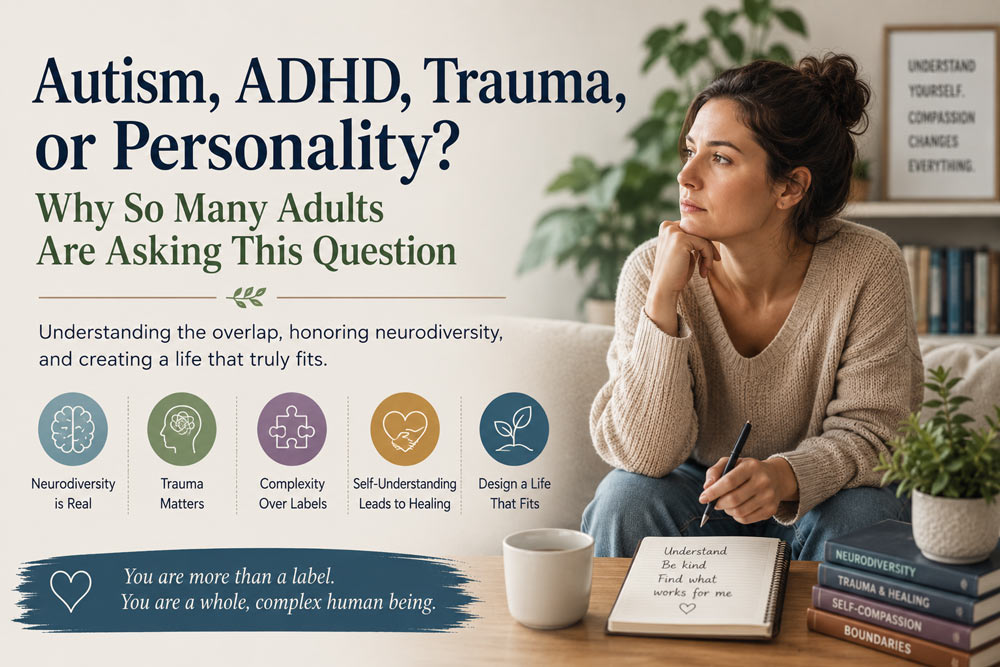
Over the past several years, a remarkable shift has occurred in therapy offices, workplaces, online communities, and around dinner tables.
People are trying to understand themselves.
Questions about autism, ADHD, trauma, anxiety, sensory sensitivity, burnout, executive functioning, and neurodiversity have become increasingly common. Many adults encounter descriptions online that feel surprisingly familiar and wonder whether they have finally found an explanation for struggles they have carried for years.
For some, the answer is yes.
A diagnosis of autism or ADHD can bring tremendous relief. Experiences that once felt confusing suddenly make sense. Longstanding challenges can be understood through a new lens, often replacing years of self-criticism with self-compassion.
At the same time, another question deserves consideration:
What if some of the difficulties people are experiencing are not solely the result of diagnoses, personality traits, or pathology? What if part of the story is that modern life has become increasingly difficult for many human beings to navigate?
A Complicated Question
One reason this conversation can become so confusing is that many experiences overlap.
- Difficulty concentrating can be associated with ADHD, but it can also result from chronic stress, exhaustion, depression, grief, sleep deprivation, or constant interruption.
- Emotional reactivity can be associated with trauma, but it can also emerge when a person’s nervous system has been operating beyond its capacity for too long.
- Social withdrawal may reflect autism, social anxiety, burnout, depression, loneliness, disappointment, or several factors at once.
Human beings rarely fit neatly into categories.
- A person can be autistic and traumatized.
- A person can have ADHD and live in an environment that continually overwhelms their nervous system.
- A person can have no diagnosable condition at all and still feel exhausted by the demands of modern life.
These possibilities are not mutually exclusive.
Living in a World That Demands Too Much
There is a quote often attributed to philosopher Jiddu Krishnamurti:
“It is no measure of health to be well adjusted to a profoundly sick society.”
Whether one agrees with the statement entirely or not, it raises an important point.
Many people are attempting to function within systems that place extraordinary demands on attention, productivity, availability, flexibility, and performance. We are expected to process enormous amounts of information, manage competing responsibilities, remain constantly reachable, and adapt to a pace of change that previous generations never experienced.
At the same time, many of the things that help human beings regulate stress have become increasingly scarce:
- Community
- Extended family
- Unstructured time
- Meaningful rituals
- Rest
- Time in nature
- Face-to-face connection
Under those circumstances, it seems reasonable to ask whether some of what we call dysfunction may also reflect a mismatch between human needs and modern expectations.
Neurodiversity Is Real
Acknowledging the impact of culture and environment does not diminish the reality of neurodiversity.
Autism and ADHD are real neurological differences, not trends or social media inventions. For many individuals, receiving an accurate diagnosis provides an invaluable framework for understanding themselves and accessing appropriate support.
The goal is not to explain away neurodiversity.
The goal is to appreciate complexity.
A diagnosis may explain part of a person’s experience, but it rarely explains all of it. Human beings are shaped by temperament, family systems, attachment history, trauma, culture, health, relationships, work environments, and countless other influences that interact in ways we are still trying to understand.
Designing a Life That Fits
One of the most meaningful shifts that occurs in therapy is when people stop asking:
How do I become more like everyone else?
And begin asking:
How do I create a life that actually works for me?
Many people spend years believing that if they were more disciplined, productive, organized, resilient, or less sensitive, everything would finally fall into place.
Yet often they are struggling against circumstances that are fundamentally out of alignment with who they are.
Examples include:
- A highly creative person depleted by rigid systems.
- A person with a sensitive nervous system overwhelmed by noise, stimulation, conflict, and stress.
- Someone who needs more solitude, recovery time, structure, movement, or predictability than those around them.
These realities are not character flaws.
They are valuable information.
Self-understanding allows us to make choices that are better aligned with how we actually function rather than how we believe we should function.
Sometimes growth involves developing new skills and increasing resilience. Other times it involves changing our environment, expectations, boundaries, or definition of success.
The goal is not to create a life without challenges. The goal is to create a life that is sustainable—a life that honors both strengths and limitations instead of constantly fighting against them.
Beyond Labels
Labels can be useful. They can provide language, validation, community, and direction.
But labels are not identities.
Nor are they the entirety of who we are.
Whether a person’s challenges stem from autism, ADHD, trauma, chronic stress, personality, burnout, or some combination of these factors, the deeper task remains the same:
Understanding oneself with honesty and compassion.
Healing rarely begins with asking:
What is wrong with me?
More often, it begins with asking:
What do I need?
That question tends to open far more doors.