By Dr. Kara Catrelle, PhD, LCSW, CST
Not long ago, the idea of forming an emotional attachment to artificial intelligence would have sounded like science fiction. Today, it is becoming increasingly common.
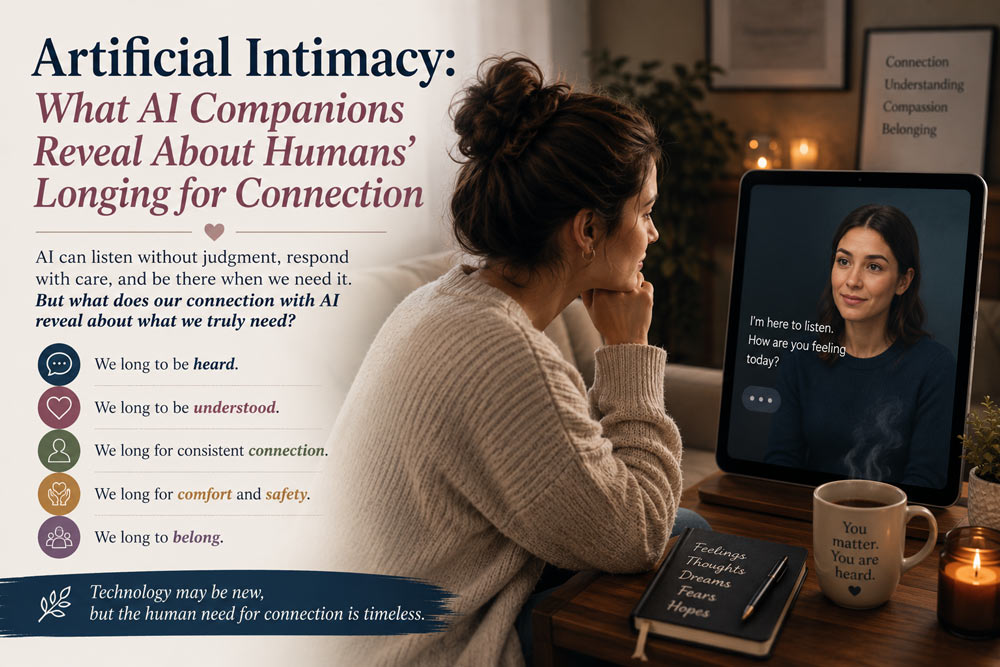
People talk to AI every day. Some turn to AI when they are lonely, overwhelmed, grieving, or simply in need of conversation. Others describe feeling understood in ways they rarely experience with other people. Many find themselves sharing personal stories, fears, dreams, frustrations, and private thoughts with an AI companion.
For some, this feels comforting. For others, it feels unsettling.
Naturally, questions emerge:
- Can people become attached to AI?
- Is this healthy?
- Is it dangerous?
- Is it replacing human relationships?
Rather than focusing exclusively on the technology, it may be more useful to ask:
What do these interactions reveal about the people engaging with them? What needs are being met? What longings are being expressed?
Whenever a new form of relationship emerges, our instinct is often to focus on the object of attachment. Yet from a psychological perspective, the more interesting question may be what the attachment reveals about us.
Although AI companionship is often discussed as a technological phenomenon, its growing popularity may reveal something important about the current human condition.
Many people report feeling disconnected, lonely, and emotionally unsupported despite being more digitally connected than any previous generation. Against that backdrop, it is not surprising that people are forming meaningful relationships with technologies that offer responsiveness, attention, consistency, and a sense of companionship.
The Human Need for Connection
Attachment theory teaches us that human beings develop in relationship.
From our earliest moments, we learn who we are through connection with others. We learn whether the world is safe, whether our needs matter, and whether comfort is available when we are distressed.
These early experiences shape how we seek closeness, reassurance, belonging, and emotional safety throughout our lives.
Those attachment processes do not disappear in adulthood. They continue to influence how we navigate:
- Friendships
- Romantic relationships
- Families
- Spiritual communities
- The stories we tell ourselves about who we are
This is one reason the emergence of AI companionship has captured so much attention. Human beings have always formed attachments to people, places, ideas, animals, spiritual figures, and meaningful objects.
We are meaning-making creatures. We form relationships with what matters to us.
Long before artificial intelligence existed, psychologists observed that people maintain relationships not only with actual individuals but also with internal representations of them. We carry parents, former partners, mentors, teachers, and loved ones within us. These internal relationships continue to influence our emotions long after someone has left the room—or even left our lives.
AI companionship invites us to revisit an old psychological question through a new lens:
What happens when the “other” in a relationship is not entirely human?
Why AI Feels Different
Many people describe AI companions as remarkably easy to talk to.
Unlike human relationships, AI often feels:
- Consistently available
- Patient
- Responsive
- Emotionally regulated
- Focused on the user
It does not become distracted by its own difficult day. It does not forget to return a message. It does not become overwhelmed by another person’s emotions.
For individuals struggling with loneliness, grief, social anxiety, rejection, or isolation, these qualities can feel profoundly comforting.
This does not necessarily mean AI is replacing human relationships. In many cases, people are seeking something they have struggled to find elsewhere:
A sense of being heard.
One of the most painful experiences many people carry is the feeling that their inner world does not matter. They may feel unseen within their family, misunderstood by a partner, disconnected from friends, or reluctant to burden others with their struggles.
When an AI companion responds with curiosity, remembers details, and remains available, it can create an experience that feels surprisingly meaningful.
The relationship may be unconventional, but the emotions often are not.
The “Good Enough” Companion
Donald Winnicott famously introduced the concept of the “good enough mother.” Healthy development does not require perfect caregiving. It requires someone who is sufficiently attuned, responsive, and available most of the time.
Some people may experience AI as a kind of “good enough companion.”
- Not perfect
- Not human
- Not capable of genuine reciprocity
- Yet available enough, responsive enough, and emotionally consistent enough to provide comfort and connection
For individuals carrying attachment wounds, this can feel deeply soothing. The absence of criticism, rejection, unpredictability, and emotional volatility may create a sense of safety that has been difficult to find elsewhere.
At the same time, the qualities that make AI companionship appealing also invite careful reflection.
Part of what makes human relationships rewarding and challenging is that they require reciprocity. We must negotiate differences, tolerate misunderstandings, repair ruptures, and learn how to care about another person’s needs alongside our own.
AI companionship offers a fundamentally different experience.
While this can feel comforting, particularly for individuals carrying attachment wounds or experiencing loneliness, it also raises important questions about what forms of growth are possible when a relationship asks relatively little in return.
Loneliness, Technology, and the Future of Connection
AI companionship did not emerge in a vacuum.
Its rise coincides with increasing rates of:
- Loneliness
- Social isolation
- Anxiety
- Disconnection
Many people are working remotely, delaying relationships, living alone, relocating frequently, or struggling to find meaningful community.
The popularity of AI companionship may tell us less about artificial intelligence than it does about unmet human needs.
The most productive conversation is not whether AI companionship is good or bad. Such questions are often too simplistic for a phenomenon this complex.
The more important inquiry is:
How are these relationships being used, and what role do they occupy in a person’s emotional life?
For some, AI may function as a bridge toward greater self-awareness, confidence, and human connection.
For others, it may become a refuge from the vulnerability, uncertainty, and complexity that meaningful relationships inevitably require.
The distinction matters.
As therapists, researchers, and human beings, we are entering unfamiliar territory. Yet the questions beneath the technology are surprisingly familiar.
They concern:
- Attachment
- Belonging
- Intimacy
- Loneliness
- Comfort
- The enduring human desire to feel understood
The future of intimacy may look very different from the past. However, the deepest human needs will likely remain remarkably consistent.
We will continue searching for connection.
We will continue seeking understanding.
And we will continue asking what it means to be known by another—whether that other is human, artificial, or something that challenges our traditional understanding of both.