Expertise
A depth-oriented approach to psychotherapy, dreams, relationships, Ayurveda, and personal transformation.
What is Depth Psychology?
The term “depth psychology” is a German term (Tiefenpsychologie) that came about in the twentieth century by Eugen Bleuler, a professor of psychiatry at the University of Zürich and director of the Burghölzli Asylum in Zürich, where C. G. Jung (1875-1961) began his career as a psychiatrist. The term refers to the ongoing development of theories and therapies later popularized by Freudians and Jungians who recognize the relationship between the conscious and the unconscious. This holistic approach focuses on the psyche, human development, personality formation, and individuation.
Depth psychology recognizes the unconscious and is a psychology of the soul or psyche. The Archetypal Self is seen as our “invisible” inner guide speaking its own language through symbol, metaphor, riddle, emotion, and the body. The inner world of the client is taken into consideration as a “living thing” with its own agenda and creative process which is outside the usual boundaries of waking consciousness.
Together we acknowledge that which is “hidden” below the surface of our logical thinking which tends to predominate our waking state of being. The way we access the hidden or unconscious realms of being is through the analytical examination of dreams, synchronistic events, active imagination, complexes, shadow qualities, transference/countertransference, projections, “slips of the tongue,” free association, and the archetypal forces at play and often reflected through our emotions. “All depth psychologists believe in the reality of the unconscious and take the whole psyche, which includes both consciousness and the unconscious, as their primary datum” (Coppin and Nelson, p. 42).
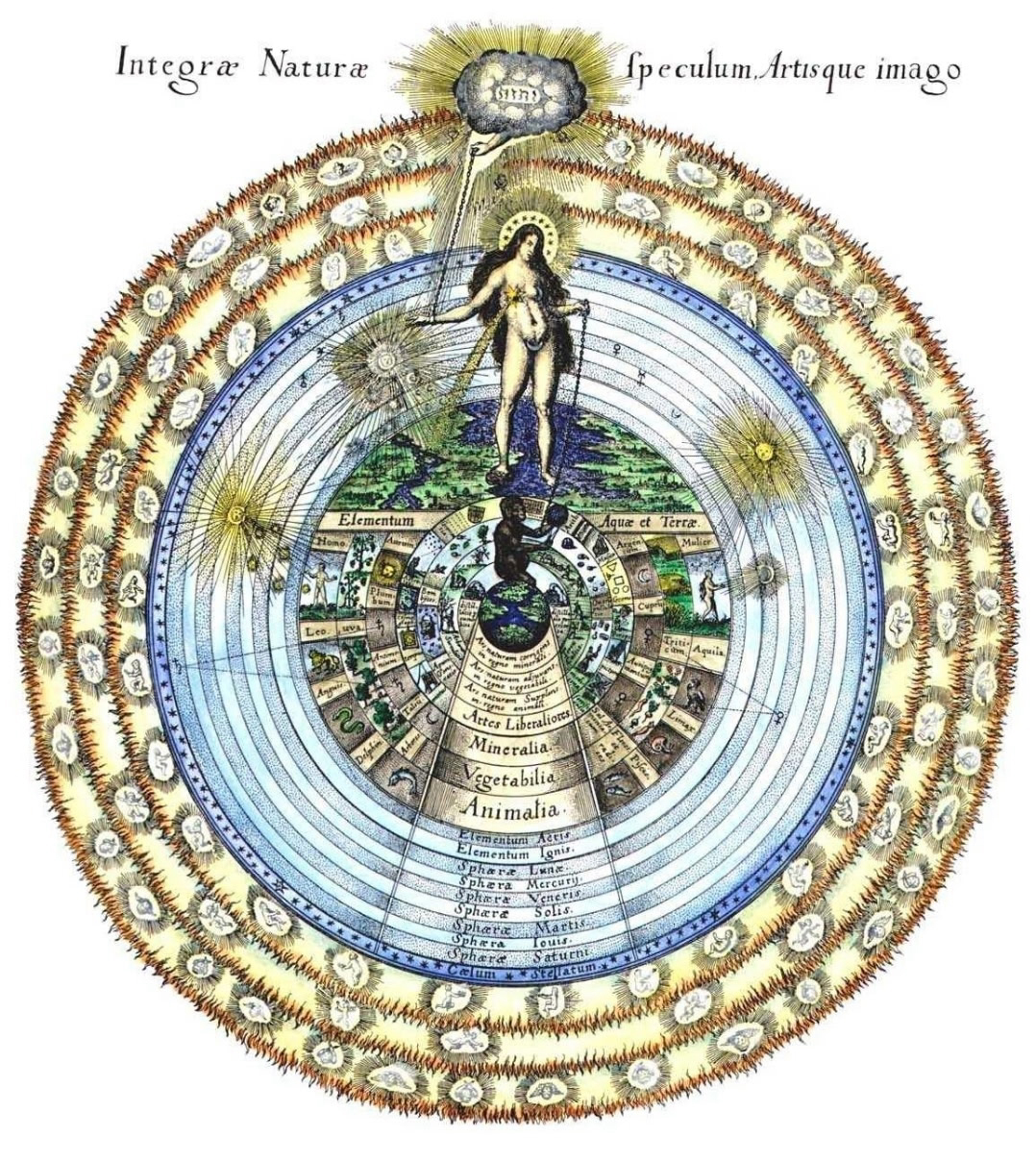
The Mirror of Nature and the Human Soul
Robert Fludd’s, Integra Naturae Speculum Artisque Imago, (1617), presents a symbolic vision of the relationship between God, nature, the cosmos, and the human being. Created nearly three centuries before Carl Jung, this remarkable engraving reflects the Hermetic belief that the macrocosm (the universe) and the microcosm (the human soul) mirror one another.
Jung regarded symbolic images such as this as powerful expressions of the collective unconscious. Rather than viewing them as scientific diagrams, he understood them as psychological maps illustrating humanity’s search for meaning, integration, and wholeness. In depth psychotherapy, these symbols remind us that healing involves more than symptom reduction; it is the lifelong process of bringing the unconscious into dialogue with consciousness. Through dreams, relationships, projections, synchronicities, and symbolic experience, we gradually become more aware of the hidden forces shaping our lives, allowing us to move toward greater authenticity and individuation.
“The essential claim of depth psychology is that there is much about being human that remains hidden to the eye. . . .Depth psychology is simply that kind of psychology that takes seriously the invisible, the secret, the unthought, and, even, the unthinkable and unspeakable. Depth psychology is nothing other than a psychology of the invisible, a psychology of the secret, a psychology of concealment as such” (Craig, E., 2007, p. 317).
Active Imagination as a tool for creativity:
On dreams …
“In the deepest sense, we all dream, not of ourselves, but out of what lies between us and the other.” ~ C.G. Jung, Letter to James Kirsch, 29.9, 1934
Since much of our waking life is spent upholding the egoic expectations through the conscious structures of family and society, our inner world often gets overlooked. Our waking life or “consciousness” is the living breathing relationship between the ego and our psychic contents. Depth psychology aims to examine that which is the unspoken. How is it that someone “has everything” and yet is so unhappy? It is interesting to ponder how we live in a country of such material wealth, however, many are spiritually starving. On the other hand, those who are very comfortable in the introverted and imaginative life experience may struggle with the demands and disappointments of day-to-day life. Psychological imbalance in the form of depression, anxiety, chronic pain, addiction, and mood disorders may come about due to an alienation from our deeper or more natural personality or what Jung refers to as “The Self.” Symptoms show us the weed in the garden, and depth psychology is the tool used to identify the root of the symptom. Psychological imbalance often leads to physiological imbalance, and these symptoms are ways by which the psyche tells us we are not listening to its deeper voice.
One of the primary tools I use in our work together involves dream analysis. I start by encouraging clients to keep a dream journal from the very beginning so that we may explore the object relations present within them. Of utmost importance are the client’s initial dreams at the start of our therapeutic relationship. From the moment we first speak, your dreams will tell us our unconscious attitude to the work, transference and countertransference, what the process of therapy will look like for us, hints of solutions and problems that will come up, whether we want to work together at all, the style and feeling of the therapeutic container, whether you are appropriate for analysis, and whether a particular archetypal field is constellated.
Throughout the therapy process, dreams show our innermost thoughts, emotions, and behaviors that are longing to come up from the unconscious into waking life expression. They allow us to “go deep sea diving” and explore unconscious psychic processes such as memories, unknown talents, repressions, and the formation of complexes that have been long since forgotten yet are unknowingly playing a role in our life. It is not uncommon to see the unconscious projections from our family members play themselves out in our dreams which then assist us in identifying them in waking life. I use dreams much like a map that helps us navigate the terrain of the psyche and a client’s path toward Individuation.
“A good therapist can help with the process of revealing the shadow to their client, but this often takes time — even years. Dream incubation, however, spears to accelerate this process of self-understanding, reveal elements hiding in the shadow of the psyche, and help a dreamer to bring about new information that actively promotes personal growth and evolution, thus allowing consciousness to see itself.” Excerpt from “Dream Incubation: A Two-Part Method of Inquiry to Reveal the Shadow,” by Kelly Lydick (Paper presented at the 16th Annual PsiberDreaming Conference, International Association for the Study of Dreams, October 1, 2017.)
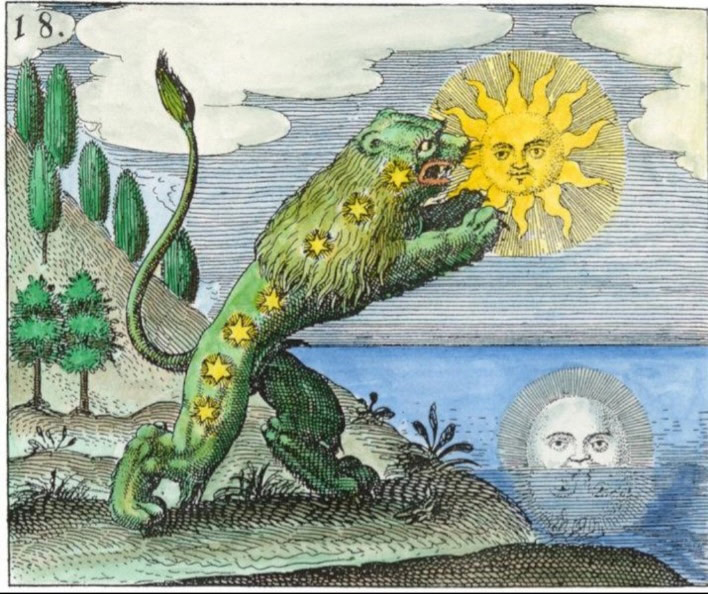
The Green Lion, Plate 18 from Rosarium Philosophorum (1550). Hand-colored woodcut. Courtesy of Wellcome Collection. Licensed under CC BY 4.0.
The Green Lion is one of alchemy’s most enduring symbols of transformation. Jung understood it as representing the powerful psychic forces that dissolve rigid patterns of identity, allowing unconscious material to emerge into awareness. In depth psychotherapy, this process often begins when long-held defenses give way to authentic self-discovery.
The Conscious Marriage
What does it mean to be in a conscious relationship? Consciousness in a relationship breaks through when the projections fall away and the spell of romance fades. Jung writes on the subject in his essay, The Development of Personality (1954/1991), Volume 17 of The Collected Works of C. G. Jung.
“Seldom or never does a marriage develop into an individual relationship smoothly and without crises. There is no birth of consciousness without pain.”
We do not enter marriage as blank slates. We bring with us the unseen influences of childhood, attachment wounds, family dynamics, trauma, unconscious beliefs, and the hidden aspects of ourselves that Carl Jung called the shadow. Left unconscious, these patterns are often projected onto our partners, creating cycles of conflict, misunderstanding, resentment, and emotional distance.
Depth psychology teaches that every intimate relationship activates the unconscious. The qualities we admire, resent, fear, or long for in our partner often reveal forgotten, wounded, or disowned aspects of ourselves. Rather than viewing these moments as evidence that the relationship is failing, we can begin to see them as invitations to greater awareness and healing.
A conscious marriage asks each partner to take responsibility for the unconscious dynamics they bring into the relationship instead of blaming one another for them. As projection gives way to self-awareness, blame gives way to curiosity, and reactivity gives way to compassion. Conflict becomes less about proving who is right and more about discovering what each person is being called to heal within themselves.
In this way, marriage becomes far more than a partnership. It becomes a sacred container for psychological and spiritual transformation—a place where two people support one another in the lifelong journey of becoming more conscious, more authentic, and more fully themselves.

Woodcut depicting the King and Queen standing atop the Sun and Moon, from Rosarium Philosophorum (1550). Courtesy of the Wellcome Collection. Licensed under CC BY 4.0.
The alchemical marriage symbolizes the union of opposites. Jung understood this image as a metaphor for the psychological task of marriage: integrating the unconscious aspects of ourselves that intimate relationships inevitably reveal.
Ayurveda
sama dosah samagnis ca sama dhatu mala kriyah
prasannatmendriya manah svastha ityabhidhiyate ll~ (Sushruta Samhita, 15.38)
“One who is established in Self, who has balanced doshas, balanced agni, properly formed dhatus, proper elimination of malas, well functioning bodily processes, and whose mind, soul, and senses are full of bliss, is called a healthy person.”
Ayurveda translated literally means “the knowledge” (veda) of “life” (ayu). The practice of Ayurveda is said to go back several thousand years and was brought forth by the great rishis (sages) of the times. These rishis provided us with holistic remedies to alleviate human suffering brought on by imbalances within the individual and the collective mindset. Ayurveda acknowledges the unique constitution of the individual, the genetics of the ancestors, the influences of nature upon the individual, and the current environment in which the native is currently living. It seeks to bring balance where there is imbalance and promote medicines and practices that actively cure disease as well as prevent disease before it settles too deeply into the tissues.

Dr. Kara Catrelle acknowledges the mind-body-spirit-soul connection recognizing that many diseases have their root cause in the mind. For example, many people who suffer from anxiety simultaneously have digestion-related problems, such as IBS and food intolerances. Interestingly, these same imbalances show up in one’s astrological natal chart. As is customary in classical Ayurvedic consultation, Dr. Kara Catrelle will consult the birth chart, take the native’s pulse, and conduct a complete Ayurvedic and Biopsychosocial assessment to determine the root causes of physical, emotional, and psychological imbalances. Herbal, aroma, and food preparation suggestions; seasonal routines; and remedial measures combined with depth psychological principles will be incorporated into the treatment phase.
Therapy as Alchemy
“The analytic journey is a journey inward.”
~ Murray Stein
“One becomes two, two becomes three, and out of the third comes the one as the fourth.”
~ Maria Prophetissima (. . .on the four stages of transformation*)
Individuation, as Jung explained, is the process of becoming authentically Oneself and living into and accepting as co-creator of Oneself. It is where we move from fate to destiny. We become a whole individual through the integration of mind, body, soul, and spirit and the penetration of the unconscious by consciousness.
Much like the alchemists of old, we can view therapeutic alchemy both practically and spiritually wherein lead (Saturn) is transmuted into gold (Sun). For the purposes of our work together, we will utilize the metaphorical process of alchemy, thus, psychologically transforming ego into the Self and ultimately uniting the unconscious (Divine) with the conscious (Human). This is also referred to as the Magnum Opus or “Great Work.”
We find man stepping onto the path of transformation through “a calling” or, in more modern terms, a spiritual awakening, emotional crisis, neurosis, trauma, unbearable suffering, addiction, psychological afflictions, or spiritual crisis. In traditional psychoanalysis, we recognize and appreciate the value in the neurosis, the shame, the compulsion, and the wound. For it is through dealing with and going into the wound consciously that the greatest possibility for transformation presents itself.
Alchemist, Steve Kalec, writes a beautiful allegory of the alchemical process of individuation:
“In the “Secret of the Golden Flower,” it is related that consciousness must inseminate the unconscious. In spiritual alchemy, it is said that consciousness is as the Sun and the Emerald Tablet of Hermes says it is the Father. The unconscious is as the moon and is the Mother. The Moon is originally dark and cold. Without the Sun it would never be seen. Yet it is this dark and cold womb that is the mother, which as Fulcanelli has said, “absorbs the rays of the sun, and secretly nurtures them in her bosom”. The Sun’s nature is such that it is radiant and outpouring of itself. It cannot receive, it is not its nature. It can only see himself in the reflection of the moon. This is very worthwhile to meditate on for that is how consciousness works.
As Hermes has said, it is the work of the Sun. Without the Sun, the Moon would not be seen, it would stay hidden and dark. Yet without the Moon, the Sun would not know itself.
If the Moon is the mother and the Sun is the Father, and an insemination is taken place as the “Secret of the Golden Flower” relates, then what is their generation, their child? To know this we must mix, blend, circulate and incubate the seed of the Sun with the womb of the Moon. What is a perfect mixture then of the Sun and the Moon? What is the perfect mixture of consciousness with unconsciousness?
This would then be that in-between substance that all alchemists seek. That thing which as Hermes says, this is the greatest force of all powers, because “it overcomes every subtle thing and penetrates every solid thing”. It is the Stone of the wise. It is the perfect body as the subtle body, for it penetrates all solid things, and it is also substantial in that it overcomes all subtle things. This is the Lunar Astral Body, embodying the rays of the Spiritual Sun. This is Mercurius as both male and female, and is the alchemical Hermaphrodite. It is the perfect reconciliation of matter and spirit.”
So how does this apply to the therapeutic work you are seeking? Let’s consider psychoanalytic psychotherapy as a “process of becoming” more of who you really are (Individuation).
First, let’s examine the Universal process of the 4 Stages of Transformation*:
I. Nigredo: The blackening dark night of the soul. . .the chaos is now unbearable as we are experiencing a “spiritual death.”
The presenting problem (pathology/neurosis/depressive state) that brings forth a type of existential terror due to a loss of libido, void of meaning, and an absence of joy. “There is an awakening of a problem (dross), secret, or distress that is poisoning me from the inside. I am being fully identified with the dilemma, feel ashamed, and am experiencing psychic toxicity and feeling overwhelmed and isolated by it.”
Symbol: A fish swimming alone in the murky river.
II. Albedo: The whitening process of becoming more conscious by entering into psychoanalysis. . . we are receiving guidance and being seen, heard, and understood by another caring person. Our “confession” is cathartic.
One looks in the mirror via the light of consciousness to see what we are dealing with . . . perhaps a loss of soul or spirit? “I am aware something is repressed or suppressed, and it is now becoming conscious. I know I must acknowledge this, and I speak a previously unspoken truth into the world.”
Symbol: A dragonfly looking down upon the fish getting a fuller more reflective or objective observation of Oneself.
III. Citrinitas: The yellowing process. . . something is developing and maturing within Oneself.
We are changing our perspective, applying discrimination, and beginning to see the dross (presenting problem) as useful and meaningful in our individuation process. One realizes a benefit to psychoanalysis, albeit uncomfortable, through greater insight and revelation that takes place as a consequence of fully experiencing the prior two stages of intense self-reflection and witnessing by another. We still feel somewhat confused or constricted, however, we have hope that we will one day fly again. “Relief or liberation is in sight.”
Symbol: A chrysalis – we are in a state of transformation and have surrendered to the process. We are no longer resistant.
IV. Rubedo: The reddening. . . emergence out of an undifferentiated unconscious and a meeting of the Self.
Rubeda is the stage of transformation wherein our perspective has shifted and we have integrated a new identity. The fruit of the previous stages has ripened and we are freed from the prison of our prior confusion, chaos, and unawareness. The Spirit within has awakened and is now expressed fully and more appropriately by applying what was discovered into our everyday lives. We make whatever changes are necessary (even if it is simply acceptance) to align more fully with our Individuated Self. We now have meaning and have synthesized into a whole being. “I recognize I can rejoin society rather than remain being ensconced in isolation due to the secret that perpetuated my separation.”
Symbol: A butterfly. . . there is a release of energy and we feel compelled to experience this newfound sensation and perspective fully. There is energy once again and we have created a new narrative. The Spirit has reentered the psyche!
Transformation goes beyond the normative. It does not encourage us to submit to a normative ideal, but rather it is about becoming the individual “genius” we were born to be.
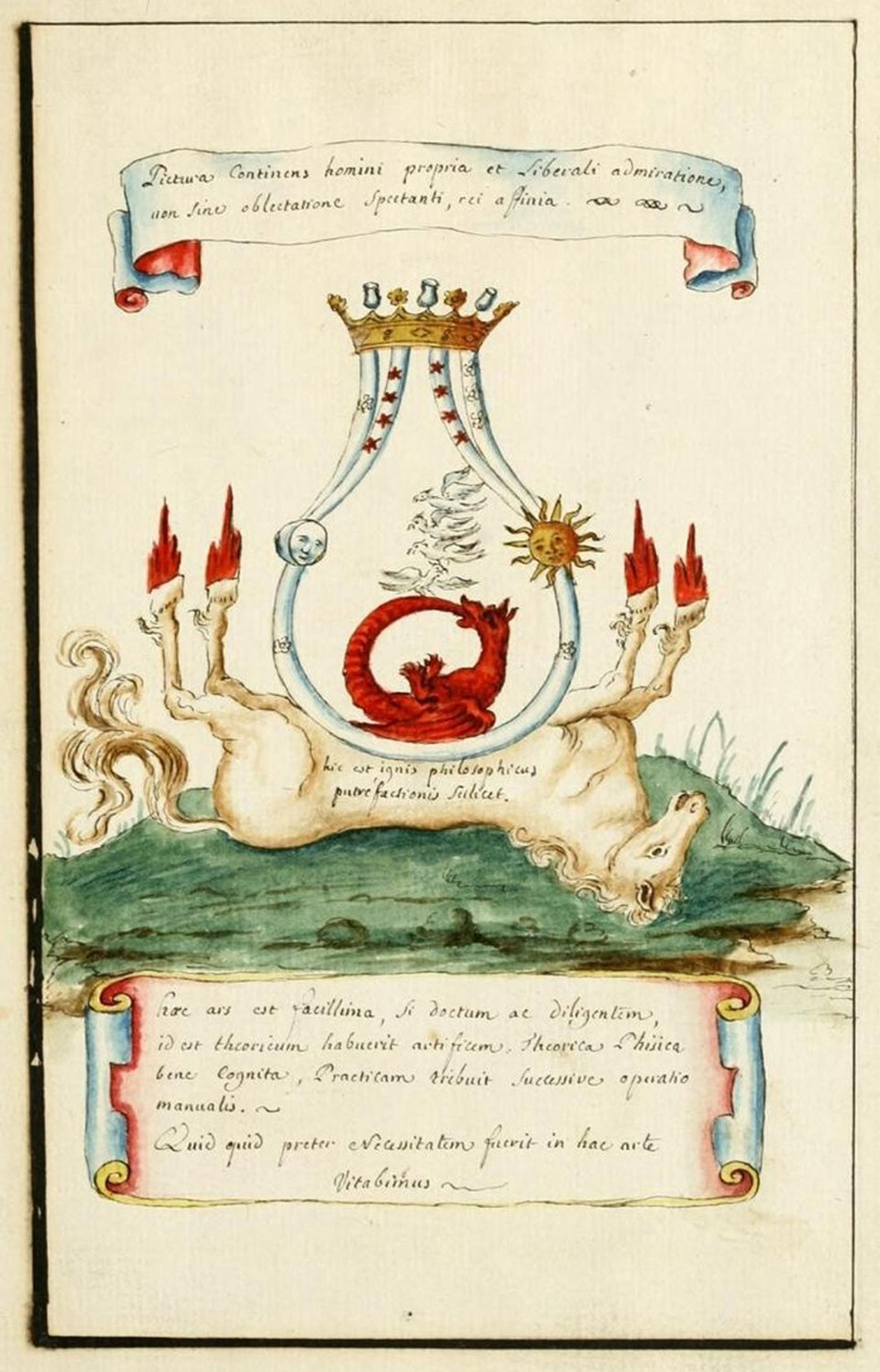
Anonymous. The Vessels of Hermes. ca. 1700. Watercolor manuscript. Getty Research Institute, Los Angeles. Public domain.
This illustration depicts the Magnum Opus—the Great Work of transformation. At its center, the sealed alchemical vessel (vas hermeticum) symbolizes the protected space in which transformation occurs. Within the vessel, the ouroboric dragon, devouring its own tail, represents the prima materia: the undifferentiated, instinctive aspects of the psyche that must first undergo dissolution before they can be renewed. Above, the Sun and Moon signify the reconciliation of opposites—conscious and unconscious, masculine and feminine, reason and intuition—whose union gives rise to psychological wholeness. The white birds represent repeated sublimation, the continual rising and purification of the material through successive stages of refinement. Beneath the vessel, the inverted horse symbolizes the Venter Equinus (“Horse’s Belly”), an alchemical furnace heated by fermenting horse manure that provided the gentle, sustained warmth necessary for putrefaction and transformation. The Latin inscription identifies this as the “philosophical fire of putrefaction,” reminding us that lasting transformation requires both time and the willingness to remain with difficult psychological material while undergoing therapy. Carl Jung understood these alchemical images as profound symbols of individuation—the process by which the fragmented psyche is gradually transformed into a more integrated and authentic self.
More specifically, we can view the psychoanalytic process (Solve et Coagula) via Alchemy as follows:
Stage 1: Calcination – Examination and acknowledgment of the Ego structure; where we break down that which stands in the way of our truer sense of Self. We question our current values, beliefs, and judgments.
Stage 2: Dissolution – The acknowledgment and reintegration of Emotion through the examination of our lives and choices up to this point in time; an encounter with the Unconscious. Through exploration of affect, dreams, complexes, and symbol, we come to know our unmet needs.
Stage 3: Separation – We examine the head and the heart; logic and intuition and the fears residing within both; examine what is of value and what is not. We separate the projections of others from our own desires, drives, shadow, and gifts.
Stage 4: Conjunction – We explore our contribution to our difficulties without judgment and unify the ego with the unconscious; unify spirit with soul (mysterium coniunctionis). We may now have the courage and inspiration to get on the path that leads us home.
Stage 5: Putrefaction/Fermentation – We relinquish our “old self” to make room for our true Essence to take center stage in our life. This often involves letting go of those obstacles that keep us from moving forward on our chosen path. We realize we must go at it alone.
Stage 6: Distillation – Here we have reached a point of emotional maturity and are free and more independent to Be. We have faced and integrated that which had been discarded and unacknowledged; we take what is left and go back into the World better than when we entered It. We value humility over hubris and contribution over accumulation. We can now be in healthy relationship with Other.
Stage 7: Coagulation – Integration of mind, body, spirit, and soul; integration of light and shadow; the holy marriage of the unconscious with the light of consciousness. We now see nirvana (the absolute, or formless) is samsara (the world of form). A new journey begins.
“Some profound inner experience of the Self does occur to most people at least once in a lifetime. From the psychological standpoint, a genuinely religious attitude consists of an effort to discover the unique experience, and gradually to keep in tune with it. . . so that the Self becomes an inner partner to whom one’s attention is continually turned.”
~ M.-L. von Franz
Areas of practice (LGBTQIA-friendly practices):
Consultation & Treatment, including, but not limited to, the following:
Dr. Kara Catrelle is available for in-person or phone sessions, as well as some group events. Please contact her via phone at 414.687.0008 or email her at kara@karacatrelle.com